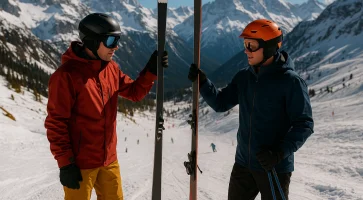
Hello, my friends, and welcome to the most exciting phase of your ski gear journey! As a lifelong skier and instructor, I’ve seen countless people make the leap from renting to owning, and I can tell you, there’s no feeling quite like clicking into your very own, perfectly chosen pair of skis. But before you make that significant investment, there’s a crucial step that separates the happy owners from the regretful ones: the ski demo.
Think of demoing skis as a test drive for your feet. You wouldn’t buy a car without taking it for a spin, and you certainly shouldn’t commit to a pair of skis without spending some quality time with them on the snow. A demo day is your opportunity to move beyond the glossy brochures and the sales pitch, and truly feel how a ski performs under your unique body and skiing style. It’s where the rubber meets the road, or in our case, where the base meets the snow.
Over my thirty years on the mountain, I’ve learned that demoing isn’t just about trying a few pairs; it’s an art and a science. It requires preparation, a system for testing, and an honest assessment of your own skiing. My goal here is to transform you from a casual tester into a pro-level ski demonstrator. We’ll cover everything from the pre-day prep to the on-snow testing strategy, ensuring you gather the right data to find your perfect match. Get ready to turn your next demo day into the most insightful and fun day of the season!
Phase 1: Pre-Demo Preparation: The Homework
Finding your perfect ski starts long before you step into the demo shop. A little homework will save you time, money, and leg-burn on the mountain.
1. Know Thyself: Define Your Skiing Profile
Before you even look at a ski, you need to be brutally honest about your own skiing. Don’t tell the shop what you wish you could ski; tell them what you actually ski.
- Skill Level: Are you a cautious intermediate, an aggressive advanced skier, or an expert who charges? This will narrow down the stiffness and performance level of the skis you should be testing.
- Terrain Preference: Where do you spend 80% of your time? Is it on groomed runs (carving), in the trees and bumps (all-mountain), or in deep powder (freeride)? This will dictate the ideal waist width and shape.
- Skiing Style: Do you prefer short, snappy turns, or long, fast arcs? Are you a dynamic, high-energy skier, or do you prefer a more relaxed, cruising style?
2. Create Your Shortlist: Research is Key
The sheer number of skis on the market can be overwhelming. Don’t walk into the demo shop blind. Use online reviews, magazine tests, and manufacturer websites to create a shortlist of 3-5 skis that align with your profile.
- Focus on Categories: Instead of picking random skis, focus on a specific category (e.g., “All-Mountain Skis, 95-105mm waist, medium-stiff flex”).
- Target Different Personalities: Within your chosen category, try to select skis with slightly different characteristics. For example, one ski that is known for its carving ability, one that excels in soft snow, and one that is a true all-rounder. This will help you identify what you truly value in a ski.
3. Dial in Your Boots and Bindings
Your ski boots are the most important piece of equipment you own. A great ski will feel terrible in a poorly fitted boot. Ensure your boots are comfortable and properly fitted before your demo day. A loose or painful boot will skew your perception of the ski. Also, make sure you know your Boot Sole Length (BSL) in millimeters, as the demo technicians will need this to adjust the bindings quickly.
Phase 2: The Demo Day Strategy: Maximize Your Time
A demo day is a race against the clock (and your leg muscles!). You need a systematic approach to get the most out of each pair of skis.
1. The Demo Shop Check-In: Be a Communicator
When you arrive at the shop, be clear and concise with the technician.
- State Your Goal: “I’m looking for a new all-mountain ski, around 98mm underfoot, and I’ve narrowed it down to these three models.”
- Be Honest About Your Weight and Skill: This is critical for setting the correct binding release value (DIN setting) and for ensuring they put you on the correct length. Don’t exaggerate your ability – safety first!
- Ask About the Ski’s Personality: Ask the technician what the manufacturer intended for the ski. “Is this ski known for its quickness or its stability?” This gives you a baseline for your on-snow test.
2. The On-Snow Testing Protocol: The Pro’s System
To compare skis fairly, you must test them under the same conditions and with the same routine. I recommend a three-run protocol for each pair of skis:
Run 1: The Groomer Warm-up (The Carving Test)
Start every ski on a smooth, groomed run. This is the most consistent surface and allows you to feel the ski’s core personality.
- Short Turns: Focus on making quick, snappy turns. How easy is it to initiate the turn? How quickly does the ski transition from edge-to-edge? A good ski should feel effortless and responsive.
- Long Turns: Open up the speed and make big, sweeping arcs. How stable is the ski at speed? Do you feel any chatter underfoot? A stable ski will feel calm and composed.
Edge Grip: Push the ski hard on the edge. Does it hold a clean arc, or does it feel like it’s washing out? A strong carving ski will feel locked into the snow.
Run 2: The Variable Terrain Test (The All-Mountain Test)
Take the ski into the type of terrain you ski most often bumps, trees, or cut-up snow.
- Moguls/Bumps: How easy is it to pivot the ski sideways? Does the ski absorb the bumps, or does it deflect you? Shorter, softer skis will excel here.
Variable Snow/Crud: Charge through the chopped-up snow. Does the ski blast through the mess, or does it get tossed around? Longer, stiffer skis with a wider waist will feel more stable. - Trees/Tight Spots: Practice quick, emergency turns. Does the ski feel nimble and easy to manage in tight quarters?
Run 3: The Powder/Off-Piste Test (The Flotation Test – Conditions Permitting)
If there’s fresh snow, this is your moment. If not, find the softest, most off-piste-like snow you can find.
- Flotation: How high does the ski ride in the snow? Do you have to lean back to keep the tips up, or do they float naturally?
- Turn Shape: How easy is it to initiate a turn in deep snow? Does the ski feel “surfy” and playful, or does it feel like it’s fighting you?
3. The Mid-Day Swap: The Comparison
After your three runs, immediately swap the ski for the next one on your shortlist. Don’t take a break! The best comparisons are made when the feeling of the previous ski is still fresh in your mind.
Phase 3: Data Collection: Record Your Impressions
A pro demonstrator doesn’t rely on memory. They rely on data. This is the most crucial part of the process.
1. The Note-Taking System: The “Three Words” Rule
After each set of runs, immediately stop and write down your impressions. I recommend the “Three Words” Rule for quick, effective comparison:
- Three Positive Words: What did you love about the ski? (e.g., Quick, Damp, Energetic)
- Three Negative Words: What did you dislike, or what did it struggle with? (e.g., Chattery, Heavy, Sluggish)
One Comparison: How did it feel compared to the last ski you tested? (e.g., More stable than Ski A, but slower than Ski B).
2. Key Performance Indicators (KPIs) to Assess
Focus your notes on these core performance indicators:
| KPI | What to Look For | Short Ski Score | Long Ski Score |
|---|---|---|---|
| Turn Initiation | How easy is it to start a turn? | Easy, effortless | Requires more muscle |
| Edge-to-Edge Speed | How quickly does the ski transition? | Fast, nimble | Slow, deliberate |
| Stability at Speed | Does the ski chatter on hardpack? | Low, often chattery | High, calm |
| Flotation | Does the tip rise easily in soft snow? | Low, sinks | High, floats |
| Energy/Rebound | Does the ski “pop” you into the next turn? | High, playful | High, powerful |
Phase 4: Post-Demo Analysis: Making the Final Call
The day is done, your legs are burning, and your notes are full. Now it’s time to analyze the data and make your final decision.
1. Identify Your Non-Negotiables
Look at your notes and identify the characteristics that consistently scored high. If “Stability at Speed” was a non-negotiable for you, eliminate any ski that you described as “Chattery.” If “Maneuverability” was key, eliminate the “Sluggish” ones.
2. Don’t Chase the Perfect Ski
Remember, the perfect ski doesn’t exist. Every ski is a compromise. A ski that is incredible in powder will be only decent on a groomer, and vice versa. The goal is to find the ski that is best for the 80% of the time you spend on the mountain.
3. The Final Consultation
Go back to the demo shop and share your notes with the technician. Their professional insight, combined with your on-snow experience, is the ultimate decision-making tool. They can explain why you felt a certain way about a ski and confirm if your findings align with the ski’s intended design.
Conclusion: Skiing with Confidence
Demoing skis is a fantastic opportunity to truly understand what you need and want from your equipment. By approaching the day with a pro-level strategy researching your profile, using a systematic testing protocol, and diligently recording your impressions you move beyond guesswork. You gain the confidence that comes from knowing you’ve chosen the perfect pair of skis, a pair that will truly enhance your ride and bring you years of pure, unadulterated mountain joy.
Now, go out there, demo like a pro, and find your perfect pair!
Happy skiing!
References
- OnTheSnow. How to Demo Skis Efficiently: https://www.onthesnow.com/news/how-to-demo-skis-efficiently/
- The Avant Ski. The Gear Guide You NEED: How to Demo Skis: https://www.theavantski.com/post/the-gear-guide-you-need-how-to-demo-skis
- Skier Deals. How to Demo Skis: Find the Perfect Pair for Your Skiing Style: https://www.skierdeals.com/winter/demo-ski-rentals/