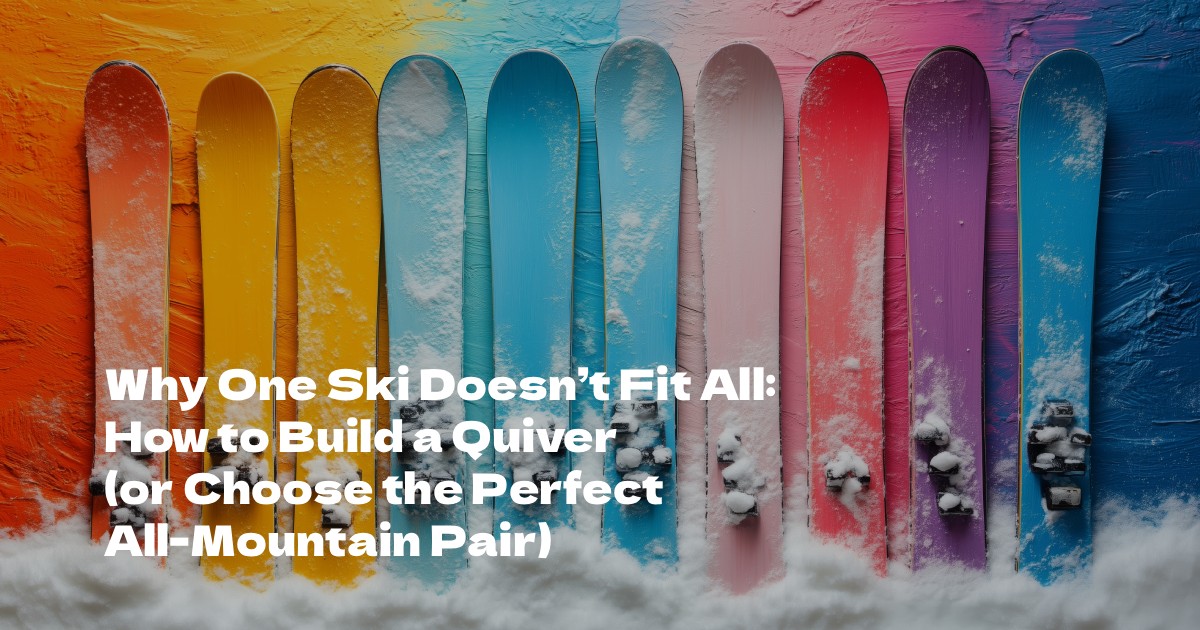
Hello, fellow mountain lovers! As a ski instructor with three decades of experience, I’ve seen the full spectrum of ski gear from the single, trusty pair that does it all, to the fully stocked ski room that rivals a small shop. And if there’s one piece of wisdom I can share with you, it’s this: no single ski can be perfect for every condition. The idea of a “one-ski quiver” is a beautiful dream, but the reality of the mountain is far too complex for one pair of planks to handle perfectly.
Think about it: would a professional golfer use the same club for a tee shot, a bunker shot, and a putt? Of course not. Each situation demands a specialized tool. The same is true for skiing. The hard, icy groomers of a cold morning require a narrow, stiff ski with maximum edge grip. The deep, fresh powder of a storm day demands a wide, rockered ski for float. The tight, technical tree runs need a short, nimble ski for quick turns.
My goal here is to guide you through the two paths to gear happiness: first, understanding the limitations of the one-ski quiver and how to choose the most versatile All-Mountain Pair if you must stick to one; and second, for those ready to take the plunge, how to strategically Build a Ski Quiver that will ensure you have the perfect tool for every day the mountain throws at you. Let’s get ready to match your gear to the conditions and elevate your entire season!
The Myth of the “One-Ski Quiver”
The term “one-ski quiver” is a popular marketing concept, and for many skiers, it’s a necessary reality due to budget or space constraints. An all-mountain ski is designed to be the ultimate compromise a jack-of-all-trades, but a master of none.
The Limitations of a Single Ski:
- The Flotation Compromise: A ski wide enough to float well in deep powder (say, 110mm+) will feel sluggish, slow edge-to-edge, and require significant effort to carve on hardpack. Conversely, a ski narrow enough to carve well on ice (say, 85mm-) will sink immediately in a foot of fresh snow.
- The Speed vs. Agility Trade-Off: A ski built for high-speed stability (long, stiff) will be a handful in tight moguls or trees. A ski built for quick, nimble turns (short, soft) will feel chattery and unstable when you open it up on a steep groomer.
- The Snow Condition Trap: The mountain changes daily, sometimes hourly. A single ski that felt great in soft spring snow will feel terrible on the bulletproof ice of mid-winter. You are forced to adapt your skiing to your equipment, rather than adapting your equipment to the conditions.
For the vast majority of skiers, the “one-ski quiver” is best defined as a highly versatile All-Mountain ski that performs acceptably in a wide range of conditions, but excellently in none.
Path 1: Choosing the Perfect All-Mountain Pair (The 80% Solution)
If you are committed to owning just one pair of skis, your focus must be on maximizing versatility. You are looking for the ski that will handle the 80% of conditions you encounter most often.
The All-Mountain Sweet Spot:
The key to the perfect all-mountain ski lies in its waist width, which should be chosen based on where you ski most often:
| Primary Skiing Location | Ideal All-Mountain Waist Width | Key Performance Focus |
|---|---|---|
| East Coast / Hardpack / Groomers | 85mm – 95mm | Edge Grip, Quickness, Carving |
| West Coast / Mixed Conditions / Powder | 95mm – 105mm | Flotation, Stability in Crud, Versatility |
| Deep Powder / Backcountry Focus | 105mm – 115mm | Flotation, Stability, All-Mountain Capability |
Other Key Criteria for the All-Mountain Ski:
- Rocker Profile: Look for a Rocker/Camber/Rocker profile. The camber underfoot provides the necessary edge grip for hardpack, while the tip and tail rocker offer float in soft snow and easy turn initiation. This is the profile of compromise and versatility [1].
- Flex: A medium-stiff flex is generally best. Too soft, and it will wash out at speed. Too stiff, and it will be unforgiving in bumps and trees. A medium-stiff flex provides the power you need without demanding expert-level technique.
- Turning Radius: Aim for a medium radius (16m – 20m). This allows the ski to make both short, snappy turns and long, stable arcs without feeling like it’s fighting you [2].
Path 2: Building the Ultimate Ski Quiver
For the passionate skier who wants to be prepared for every condition, building a quiver is the ultimate solution. A quiver is a collection of specialized skis, each designed to excel in a specific environment. The goal is to have the right tool for the job, ensuring every day on the mountain is a perfect one.
The Essential 3-Ski Quiver:
A three-ski quiver is the most practical and effective setup for a dedicated skier. It covers the three main conditions you will encounter: hard snow, mixed conditions, and deep powder.
1. The Frontside/Carving Ski (The Hardpack Specialist)
- Purpose: Maximum performance on groomed runs, hardpack, and ice.
- Waist Width: < 85mm (often 70mm – 85mm).
- Key Features: Stiff flex, full camber or minimal tip rocker, and a short turning radius (12m – 15m) for aggressive, carved turns.
- When to Use: Cold mornings, icy conditions, days when there hasn’t been fresh snow, or when you want to focus purely on carving technique.
. The All-Mountain Ski (The Daily Driver)
- Purpose: The workhorse. Handles the majority of days with mixed conditions, light powder, and variable terrain.
- Waist Width: 90mm – 105mm.
- Key Features: Medium-stiff flex, rocker/camber/rocker profile, and a medium turning radius (16m – 20m).
- When to Use: Your go-to ski. Use it when you don’t know what the conditions will be, or when you plan to ski a mix of groomers, bumps, and trees.
3. The Powder/Freeride Ski (The Deep Day Specialist)
- Purpose: Maximum flotation and stability in deep powder, crud, and variable off-piste snow.
- Waist Width: > 110mm (often 115mm – 125mm).
- Key Features: Softer flex (for a surfy feel), significant tip and tail rocker, and a long turning radius (> 20m) for stability and float.
- When to Use: Storm days, deep powder days, or when you are exclusively skiing off-piste and big-mountain terrain.
Expanding Your Quiver (The 4-Ski and Beyond)
For the truly obsessed, the quiver can be expanded to include even more specialized tools:
- The Touring Ski: A lightweight version of your All-Mountain or Powder ski, designed with specific binding inserts for uphill travel (ski mountaineering or “skinning”). Weight is the primary concern here.
- The Park Ski: A twin-tip ski with a symmetrical shape, designed for riding switch, jumping, and hitting rails. Often shorter and softer for maximum playfulness and forgiveness.
- The Mogul Ski: A narrow, often straight-tailed ski with a stiff flex, designed for quick, precise turn initiation and stability in the bumps.
The Quiver in Harmony: How the Skis Complement Each Other
The beauty of a quiver is that the skis should complement, not overlap, each other. The differences in waist width, turning radius, and profile should be distinct enough to justify the need for each pair.
| Ski Type | Waist Width (mm) | Rocker Profile | Primary Function |
|---|---|---|---|
| Carving/Frontside | < 85mm | Full Camber | Edge Grip, Short Turns, Hardpack |
| All-Mountain | 90mm – 105mm | Rocker/Camber/Rocker | Versatility, Daily Driver, Mixed Conditions |
| Powder/Freeride | > 110mm | Significant Rocker | Flotation, Stability, Deep Snow |
Conclusion: Choose Your Tools Wisely
The truth is, one ski doesn’t fit all because the mountain doesn’t offer one condition. The snow is a dynamic, ever-changing environment, and the best skiers are those who can adapt to it.
If you are a casual skier, choose the perfect all-mountain ski the 80% solution and accept its limitations. If you are a dedicated enthusiast, embrace the quiver. By strategically selecting a few specialized pairs, you are not just buying more gear; you are investing in the ability to have the perfect day, every day, regardless of what the weather brings.
The mountain is calling, and now you know how to answer it with the right tool in hand. Happy skiing!
A Note on Ski Length in a Quiver
When building a quiver, you might also consider varying the length of your skis, not just the width. This is a pro-level move that further refines your performance:
- Carving/Frontside Ski: Often chosen on the shorter end of your recommended range (e.g., 175cm for a 6’0″ skier). The shorter length complements the deep sidecut, making the ski incredibly quick edge-to-edge and allowing for those tight, snappy turns that are the hallmark of a great carver.
- Powder/Freeride Ski: Almost always chosen on the longer end of your recommended range, or even slightly above (e.g., 188cm for a 6’0″ skier). The extra length provides crucial stability at high speeds in variable snow and maximizes the surface area for superior float in deep powder. The significant rocker profile on these skis prevents the extra length from feeling cumbersome.
- All-Mountain Ski: This ski should sit right in the middle (e.g., 182cm for a 6’0″ skier), offering the best compromise between the agility of the carver and the stability of the powder ski.
By varying the length, you are ensuring that each ski is optimized for its specific purpose, rather than just relying on the waist width alone. This is the final step in truly building a quiver that is greater than the sum of its parts. It’s about having a collection of tools that are each perfectly honed for their intended job, allowing you to ski with maximum confidence and performance, no matter the conditions.
The Final Word: Invest in Experience
Ultimately, the choice between a single all-mountain ski and a multi-ski quiver is an investment in your experience. The single ski is a great entry point, offering the freedom to explore the whole mountain without the hassle of multiple pairs. The quiver, however, is an investment in perfection. It ensures that on the deepest powder day, you are not fighting a narrow ski, and on the iciest groomer, you are not struggling to engage the edge of a wide, floppy ski. It’s the difference between a good day and a truly epic one. Choose the path that aligns with your passion and your commitment to the sport. The snow is waiting!
References
- Switchback Travel – How to Choose All-Mountain Skis: Length, Width, Flex & More: https://www.switchbacktravel.com/info/how-to-choose-all-mountain-skis
- Renoun – How To: Build a Quiver. Why you might need multiple skis: https://renoun.com/blogs/blog/how-to-build-a-quiver
- Christy Sports – How to Build your Perfect Ski Quiver: https://www.christysports.com/blog/build-your-perfect-ski-quiver.html